 Español
  ایران
ایران 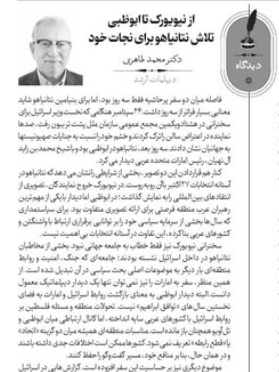

This post is also available in:
From New York to Abu Dhabi: Netanyahu’s Bid to Save Himself
Dr. Mohammad Taheri
Only three days separated two controversial trips, but for Benjamin Netanyahu they may have meant far more than three days. On 24 September, as the Israeli prime minister took the podium at the 81st UN General Assembly, hundreds of delegates walked out in protest, showing the world their anger at Israel’s crimes. Three days later, Netanyahu was in Abu Dhabi meeting Sheikh Mohammed bin Zayed Al Nahyan, President of the United Arab Emirates.
Placed side by side, these two images reveal part of the situation Netanyahu faces ahead of the 27 October Israeli election. In New York, the walkout displayed international criticism; in Abu Dhabi, meeting one of the region’s most important Arab leaders offered a chance to project a different image. For a politician who has built much of his political capital on his ability to work with Washington and Arab states, that contrast matters on the eve of an election.
A speech for a domestic audience
The New York speech was not addressed only to the international community. Part of Netanyahu’s audience was inside Israel, a society in which war, security and regional relations have once again become central political issues. Seen this way, the trip to the UAE cannot be treated as just a routine diplomatic visit.
The Abu Dhabi meeting does not mean Israel–UAE relations have returned to the atmosphere of the early Abraham Accords years. Regional developments and the Palestinian question have cast a shadow over Israel’s ties with Arab states, yet the channel between Abu Dhabi and Tel Aviv remains open. Regional relations are not always defined as either “alliance” or “rupture”; countries can have serious disagreements while keeping dialogue alive in line with their interests.
The shadow of 7 October and the war with Iran
Another issue has added to the sensitivity of the trip. Reports in Israel claim that Mohammed bin Zayed warned of a possible major Hamas operation before the 7 October 2023 attack. Netanyahu’s office has denied this, but the claim has brought the question of political and security responsibility for 7 October back into public debate, a file that still weighs on his government’s record.
At the same time, the war with Iran, missile strikes on Israeli cities and damage to infrastructure and military sites have affected Israel’s security climate and put security back at the centre of political and military debate—the very field in which Netanyahu has long sought to define much of his political identity.
The flydubai incident and the election climate
A few days earlier, Netanyahu warned that there were signs Israel’s enemies might attack before the election. Just one day later, an incident occurred on a flydubai flight from Dubai to Tel Aviv. The timing quickly pulled it into Israel’s political and electoral arena: Netanyahu’s rivals called it suspicious and accused the prime minister of trying to use it to strengthen his security image.
Yair Lapid, former prime minister and current opposition leader, said that at a security briefing with Netanyahu the day before the incident, no threat similar to what happened on the flydubai flight had been raised.
Some have even suggested the flydubai incident was fabricated by Netanyahu as part of an effort to create a climate of threat. No credible evidence has been published to support such a claim, but the very fact that such speculation is circulating shows how closely the incident has become tied to Israel’s election atmosphere.
Security as an election strategy
Netanyahu now faces a tough election and serious questions about his government’s record. His critics argue that by highlighting security threats and terrorism, he is trying to reinforce the perception that Israel faces a grave threat and that only he can restore security and prosperity. In their view, shifting the debate from the government’s responsibility for 7 October to future threats may be part of his strategy to win public support and more seats.
From this angle, the Abu Dhabi trip gains greater political meaning. At home, Netanyahu presents himself as the guarantor of security; abroad, he seeks to show that despite international pressure, Israel is not isolated and can still talk to major Arab states. Two seemingly different images pursue a single electoral message: a leader who claims he can both confront threats and preserve Israel’s regional relations.
From New York to Abu Dhabi, and from security warnings to the flydubai incident, Israel’s election race is more tied to security than ever. The key question is whether Netanyahu can, by highlighting new threats, shift public attention from the lingering questions about 7 October and his government’s record toward the future. The answer will come not from speeches in New York or meetings in Abu Dhabi, but from Israeli voters on 27 October.
Source (Persian): Ettelaat newspaper
