 Español
 ایران

This post is also available in:
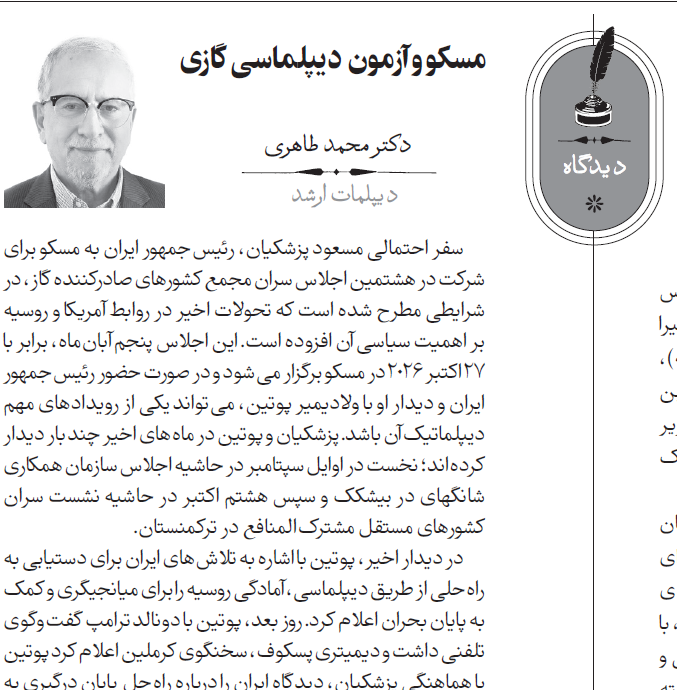
Moscow and the Test of Gas Diplomacy
Dr. Mohammad Taheri
Iranian President Masoud Pezeshkian’s possible trip to Moscow for the 8th Summit of the Gas Exporting Countries Forum (GECF) comes at a time when recent shifts in US–Russia relations have raised its political weight. The summit takes place in Moscow on 27 October 2026 (5 Aban 1405), and if Iran’s president attends and meets Vladimir Putin, it could become one of its most important diplomatic moments.
Pezeshkian and Putin have met several times in recent months: first in early September on the sidelines of the Shanghai Cooperation Organisation summit in Bishkek, and then on 8 October on the sidelines of the Commonwealth of Independent States summit in Turkmenistan.
From an offer of help to passing on messages
At their latest meeting, Putin referred to Iran’s efforts to reach a diplomatic solution and declared Russia’s readiness to mediate and help end the crisis. The next day, Putin spoke by phone with Donald Trump, and Kremlin spokesman Dmitry Peskov said that Putin, in coordination with Pezeshkian, had conveyed Iran’s view on a way to end the conflict to Trump, although most of the call was devoted to Ukraine.
The significance of this is that Moscow’s offer to help resolve the crisis has become a practical step, at least at the stage of passing on messages. The content of Iran’s proposal and Washington’s response have not yet been made public, but the call itself shows that Moscow has a channel of communication with both sides.
For this reason, Pezeshkian’s possible visit to Moscow cannot be seen as merely a ceremonial appearance at an economic summit. A meeting with Putin could be an opportunity to review the results of these contacts and assess Washington’s positions.
The Gas Exporting Countries Forum and Iran’s role
The Gas Exporting Countries Forum, also known as the “gas OPEC”, took shape in 2001 with the first meeting of gas-exporting countries’ ministers in Tehran, and gained a formal structure in 2008 when its statute was adopted in Moscow. Its permanent secretariat is based in Doha.
Since the forum’s inception, Iran has played an important part in developing cooperation among gas-rich countries. Dr. Mohammad Hossein Adeli served as its Secretary General from 2014 until the end of 2017, and its third summit was held in Tehran in November 2015. The forum’s members and observers hold a large share of the world’s gas reserves and, from this perspective, occupy a significant place in the future of the global energy market.
The shadow of war over energy security
The Moscow summit is taking place while the consequences of the war between Iran on one side and the United States and Israel on the other still weigh on the security of the Persian Gulf and energy transport routes. Disruptions to energy facilities and shipping around the Strait of Hormuz have heightened concern among both producers and consumers.
The effects are not limited to energy. Natural gas is a key feedstock for ammonia and chemical fertilisers, so higher prices or supply disruptions can affect agricultural output and food security in many countries.
Washington’s shifting approach to Moscow
Alongside these considerations, the change in US policy towards Russia is also notable. On 16 October, Donald Trump issued an order suspending the new sanctions and tariffs imposed on Russia under the Graham Act. The decision followed an agreement between Trump and Putin on the supply of Russian diesel to the global market.
This does not mean that all sanctions on Russia have been lifted; earlier sanctions remain in place. It may, however, signal a change in Washington’s approach to Moscow. The pressure of rising fuel prices on the US economy, especially ahead of the congressional midterm elections, appears to have played a part in this shift.
Russian mediation: possibilities and limits
Such an environment could strengthen Russia’s diplomatic capacity to talk to both sides. Thanks to its strategic relations with Iran and its direct channels to the United States, Russia is in a position to pass on messages and help bring the two sides’ views closer.
Still, the possibility of mediation must be distinguished from its success. Russia pursues its own interests, and higher global energy prices have created economic opportunities for it as one of the world’s major oil and gas exporters. A swift end to the crisis may therefore not align, in the short term, with all of Moscow’s economic interests.
On the other hand, an effective role in reducing tension could enhance Russia’s international standing and help ease instability in the Middle East. For Iran, too, using Russia’s diplomatic capacity can be part of a broader effort to reduce tension and reach a lasting agreement, provided that the country’s independent decision-making is preserved and other regional and international channels are also used.
The Moscow summit: a test beyond the gas market
On one hand, the Moscow summit offers an opportunity to stress the need to protect energy infrastructure, respect the rights of producing countries, secure shipping in the Persian Gulf and prevent the war from spreading. On the other, it opens room to pursue ways of easing tension between Tehran and Washington on the sidelines of political talks.
The importance of Pezeshkian’s possible visit lies in the link between two issues: Iran’s place in global energy cooperation, and the new opening that may have emerged in Russia–US relations for easing the crisis. According to the Kremlin, Putin has conveyed Iran’s views to Trump, and Washington has shown signs of a changing approach towards Moscow. Turning these contacts into an effective process, however, requires political will on both sides and clear, workable understandings.
Beyond being a meeting about the future of the global gas market, the 27 October summit in Moscow could become a test of Russia’s diplomatic role in one of the region’s most sensitive crises. A Pezeshkian–Putin meeting could also make clearer whether Moscow can move from being a messenger to becoming an effective facilitator of dialogue between Tehran and Washington; a role that, if successful, could help reduce tensions, strengthen security in the Persian Gulf and restore stability to the region.
Source (Persian): Ettelaat newspaper
Dr. Mohammad Taheri, President of the Iran–Spain Joint Chamber of Commerce
