 Español
 ایران

This post is also available in:
ISBC Health Committee Secretary at iMED 2026: Spain, a Strategic Base for Medical Device Production and Exports
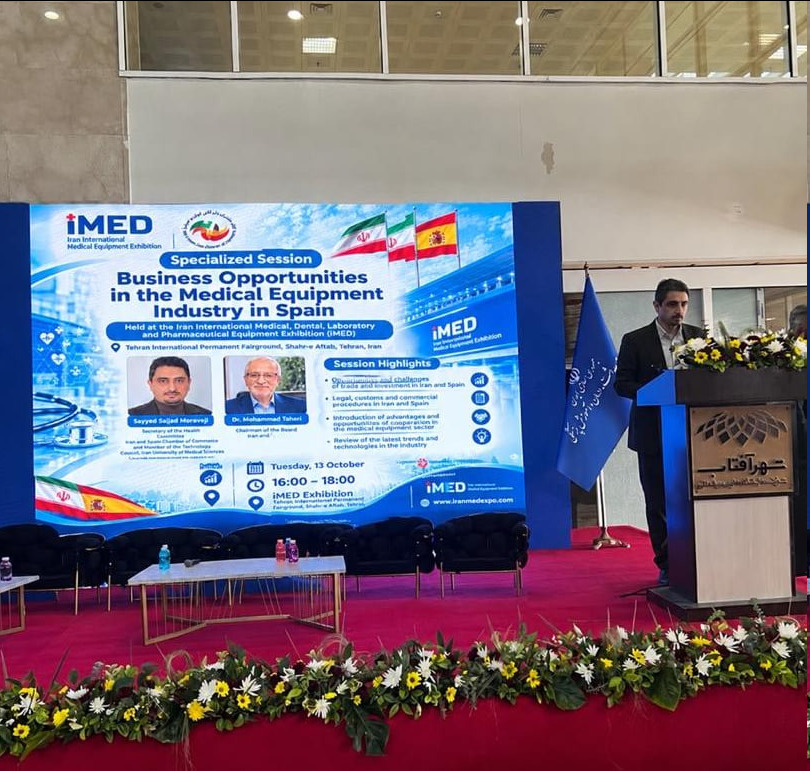
Dr. Seyed Sajjad Moravveji, Secretary of the Health Committee of the Iran–Spain Joint Chamber of Commerce, spoke at the expert session “Business Opportunities in Spain’s Medical Equipment Industry” on the sidelines of the international medical equipment exhibition iMED 2026 at Shahr-e Aftab in Tehran. He outlined Spain’s place in Europe’s medtech industry and stressed its potential for manufacturing sites, assembly and packaging lines, and the export of medical devices to international markets.
The session was held on Tuesday, 13 October 2026 (21 Mehr 1405), organized by the Chamber’s Health Committee. Dr. Moravveji, also a member of the Technology Council of Iran University of Medical Sciences, presented Spain as a serious option for companies seeking to expand production and trade in Europe and beyond.
Spain’s place in Europe’s medical device market
In 2025, Spain ranked among Europe’s five largest medical device markets, alongside Germany, France, the United Kingdom and Italy. Europe’s medtech market that year was estimated at about €173 billion. Entering such a market requires not only understanding domestic demand but also industrial structure, technical standards and cooperation with local manufacturers.
Citing Fenin data from February 2026, Moravveji said that of nearly one thousand companies in Spain’s medtech sector, 362 specialise in producing medical technologies and products. They operate more than 170 manufacturing and R&D centres, and about 93% are SMEs.
According to Fenin’s annual report, the sector’s turnover in 2024 reached about €11.6 billion, with exports exceeding €4.9 billion. Export growth of around 7% year on year shows that Spanish firms are not limited to the domestic market.
From direct exports to production and assembly in Spain
A major part of the session focused on setting up production in Spain. Moravveji argued that foreign-market presence should not be reduced to direct exports or finding a sales agent. Depending on technical capacity, capital and international plans, companies can consider building a plant, partnering with local manufacturers, launching final assembly or specialised packaging lines, or co-developing medical products.
Spain’s network of manufacturers, R&D centres and industrial infrastructure can help identify partners. The right model, however, must match product type, technology level, production costs, legal requirements and the economic case for each project.
Spain as an export base beyond the EU
Moravveji also framed Spain as a base for export strategies beyond the European Union. With the right technical, economic and regulatory conditions, production in Spain can support exports to Europe, Africa, South America and East Asia.
EU membership and access to the single market are clear advantages for manufacturers that meet legal and standards requirements. Production or assembly in Spain does not by itself grant EU market authorisation or European origin; compliance with EU medical device rules, including MDR and IVDR, and with rules of origin remains essential.
Geographic proximity to North Africa, historical and linguistic ties with Latin America, and specialised demand in East Asia were also discussed. Entry into each market must rest on specialist studies, local regulation, logistics costs and competitive conditions.
A strategic approach for Iranian companies
Companies planning to expand abroad, Moravveji said, need a coherent link between production capacity, investment location, target-market access and risk management. A plant or assembly line in Spain becomes a lasting advantage only when it is economically justified and aligned with legal requirements, quality standards, supply of inputs and the export plan.
Iranian firms in hospital equipment, laboratory technologies, diagnostic devices and related health products can use knowledge of Spain’s medtech structure to assess cooperation ranging from product development and know-how exchange to joint production, assembly, packaging and distribution networks. Delivering on these opportunities requires careful feasibility work, credible partners, legal due diligence and attention to banking, financial and trade constraints.
Cooperation with Spain should therefore not be seen only as buying and selling medical equipment. Industrial capacity, specialised company networks and commercial links can open broader forms of partnership that, with careful planning and compliance, can become long-term production and trade projects.
Full report (Persian): Read on Telegraph
Health Committee, Iran & Spain Joint Chamber of Commerce
Secretariat of the Iran & Spain Joint Chamber of Commerce
